4. Loading glTF models and animations
Sections
Reading settings
No voice for this language in this browser.
More voices
Code and English terms
Off: the page’s voice reads everything, with no pause between two voices.
No voice for this language in this browser.
More voices
More voices: Microsoft Edge has natural online voices, and Windows (Settings › Time & language › Speech), macOS and Android install others.
Code: the page in src/04-gltf/main.ts, the model writer scripts/make-models.ts, what the loader builds in scripts/l04-gltf.ts, and the exercises in scripts/l04-exercises.ts.
glTF, the format three.js expects
Section titled “glTF, the format three.js expects”glTF 2.0 is a Khronos standard, like OpenGL and Vulkan, for sending 3D scenes to an application that renders them. Khronos calls it “the JPEG of 3D”: a delivery format, not an editing format like a Blender file. A glTF asset holds a scene graph of nodes, meshes whose buffers map directly to GPU buffers, metallic-roughness materials (the model of lesson 2), textures, cameras, skins and animations.
It comes in two forms: a .gltf JSON file with separate .bin and image files, or a single binary .glb that packs them together. Blender exports it, as do most 3D tools and asset stores.
| MonoGame | WPF 3D | three.js | |
|---|---|---|---|
| Model files | FBX or X, compiled at build time by the content pipeline into .xnb |
no loader: XAML or code, or a third-party library | glTF 2.0, loaded at run time by GLTFLoader |
| What a load gives | a Model with meshes and bones |
a Group with Mesh, Object3D, Bone children, plus animation clips |
|
| Animations | your code, or a library | Storyboard and AnimationClock |
AnimationClip played by AnimationMixer |
| Compression | the pipeline’s formats | Draco or meshopt for geometry, KTX2 for textures, each with its own decoder |
A model written by a script
Section titled “A model written by a script”To keep every byte reproducible, the course doesn’t download a model: scripts/make-models.ts builds a metronome from three.js primitives and writes it with glTF Transform, a library for reading, editing and writing glTF in Node.js. A tapered body, and an arm made of a rod and a weight that swings from +25° to −25° and back in one second.
Two details of the script matter for any model:
- The arm’s pivot is its node’s origin. The rod’s geometry is moved up by half its length, and the arm node sits at the bottom of the rod, in front of the body, so rotating the node swings the arm around its bottom (lines 54-57). A model whose parts rotate around the wrong point was exported with the wrong origins.
- Material colors in glTF are linear.
baseColorFactorholds linear values, so the script converts its sRGB hex colors withTHREE.Colorfirst (line 21);GLTFLoaderreads the factor asLinearSRGBColorSpaceand a base color texture asSRGBColorSpace(GLTFLoader.js, lines 829-836), the rules of lesson 3.
The animation is a glTF channel that targets the arm’s rotation with five quaternions, one every quarter second, linearly interpolated (lines 62-72):
// One animation, "swing": arm rotation around Z, as quaternions (x, y, z, w), linearly interpolatedconst angles = [0, 25, 0, -25, 0];const times = document.createAccessor('swing_times').setType(Accessor.Type.SCALAR).setArray(new Float32Array([0, 0.25, 0.5, 0.75, 1])).setBuffer(buffer);const rotations = document .createAccessor('swing_rotations') .setType(Accessor.Type.VEC4) .setArray(new Float32Array(angles.flatMap((deg) => new THREE.Quaternion().setFromAxisAngle(new THREE.Vector3(0, 0, 1), THREE.MathUtils.degToRad(deg)).toArray()))) .setBuffer(buffer);const sampler = document.createAnimationSampler().setInput(times).setOutput(rotations).setInterpolation('LINEAR');const channel = document.createAnimationChannel().setTargetNode(arm).setTargetPath('rotation').setSampler(sampler);document.createAnimation('swing').addSampler(sampler).addChannel(channel);The script writes the model three times, as it is and with each geometry compression:
$ node scripts/make-models.tsmetronome.glb 58540 bytes, 24239 gzippedmetronome-draco.glb 10424 bytes, 7438 gzippedprune: Removed types... Accessor (12)prune: Removed types... Accessor (9)metronome-meshopt.glb 24616 bytes, 7526 gzippedWhat GLTFLoader builds
Section titled “What GLTFLoader builds”GLTFLoader runs in Node.js too, as long as the file has no images to decode and no Draco geometry, which DRACOLoader decodes in Web Workers. scripts/l04-gltf.ts parses the uncompressed file and prints the tree:
$ node scripts/l04-gltf.tsGroup "metronome" Object3D "metronome_1" Mesh "body" — 48 vertices, MeshStandardMaterial "walnut" Object3D "arm" Mesh "rod" — 24 vertices, MeshStandardMaterial "brass" Mesh "weight" — 1225 vertices, MeshStandardMaterial "brass"asset: { generator: 'glTF-Transform v4.5.0', version: '2.0' }clip "swing": 1 s, tracks arm.quaternion (5 keys, QuaternionKeyframeTrack)...gltf.sceneis aGroupnamed after the glTF scene, and each glTF node becomes anObject3D, or aMeshwhen it has one. The script’s root node was also called “metronome”;GLTFLoadermakes names unique, and renames it “metronome_1” (createUniqueName). Code that looks objects up withgetObjectByNamedepends on those names, so agree on them with whoever exports the model.- The materials are
MeshStandardMaterial, with the glTF material’s name. Extensions such asKHR_materials_clearcoatturn them intoMeshPhysicalMaterial. - The animation becomes an
AnimationClipingltf.animations, with one track per animated property, namednode.property:arm.quaternion. A clip is data, not tied to an object: the node names in the track names connect it to a scene.
Playing the animation
Section titled “Playing the animation”AnimationMixer plays clips on the objects under a root. clipAction(clip) returns an AnimationAction, the equivalent of a WPF AnimationClock: it has its own time, speed (timeScale), weight and loop mode, and several actions can blend on the same objects. Nothing moves until you call mixer.update(delta) with the seconds since the last frame, usually from the animation loop and a Timer.
The same script steps the mixer by hand and reads the arm’s angle:
t = 0.000 s: arm at 0°t = 0.125 s: arm at 12.5°t = 0.250 s: arm at 25°t = 0.500 s: arm at 0°t = 0.750 s: arm at -25°t = 1.250 s: arm at 25°timeScale 2, then 0.125 s more: t = 0.500 s in the clip, arm at 0°meshopt weight position: Int16Array normalized true scale [ 0.09, 0.09, 0.09 ]- Between two keys, the angle is interpolated: 12.5° at 0.125 s, halfway between 0° and 25°. Quaternion tracks are interpolated with a spherical interpolation, which gives the same halfway angle for a rotation around a single axis.
- The clip loops by default (
LoopRepeat): at 1.25 s, the arm is where it was at 0.25 s.mixer.timekeeps counting, and each action wraps its own time. - With
timeScale = 2, 0.125 s of real time moves the action by 0.25 s in the clip, from 0.25 to 0.5.
Compressed geometry: Draco and meshopt
Section titled “Compressed geometry: Draco and meshopt”The uncompressed file is 58,540 bytes, mostly float vertex data. Two glTF extensions compress it, and both need a decoder in the browser:
- Draco (
KHR_draco_mesh_compression), from Google, encodes a mesh’s connectivity and quantized attributes into a compact bit stream. It gives the smallest files, and needs a WebAssembly decoder of a few hundred kilobytes, run in Web Workers. - meshopt (
EXT_meshopt_compression), from meshoptimizer, reorders and encodes the buffers so that gzip or Brotli compresses them well, and aims at fast decoding. Here it comes withKHR_mesh_quantization, which stores positions and normals as small integers instead of floats. Its decoder is a JavaScript module with embedded WebAssembly.
| File | Bytes | Gzipped |
|---|---|---|
metronome.glb |
58,540 | 24,239 |
metronome-draco.glb |
10,424 | 7,438 |
metronome-meshopt.glb |
24,616 | 7,526 |
On disk, Draco is 2.4 times smaller than meshopt; over an HTTP connection that compresses, they are within 1 %. That is meshopt’s design: it leaves the last step to the web server. The last line of the script’s output shows quantization: the weight’s positions came back as a normalized Int16Array, with a scale of 0.09 on the node to restore the sphere’s radius.
The page loads the three files with one loader (main.ts, lines 25-44):
// One loader for the three files: it picks the decoder that each file's extensionsRequired asks forconst loader = new GLTFLoader().setDRACOLoader(new DRACOLoader()).setMeshoptDecoder(MeshoptDecoder);
const files = ['metronome.glb', 'metronome-draco.glb', 'metronome-meshopt.glb'];const mixers: THREE.AnimationMixer[] = [];const loaded: Record<string, unknown> = {};const models = await Promise.all(files.map((file) => loader.loadAsync(`generated/${file}`)));
models.forEach((gltf, i) => {  gltf.scene.position.x = (i - 1) * 1.6;  scene.add(gltf.scene);  const mixer = new THREE.AnimationMixer(gltf.scene);  mixer.clipAction(gltf.animations[0]).play();  mixers.push(mixer);  let vertices = 0;  gltf.scene.traverse((object) => {    if ((object as THREE.Mesh).isMesh) vertices += (object as THREE.Mesh).geometry.getAttribute('position').count;  });  loaded[files[i]] = { extensionsUsed: gltf.parser.json.extensionsUsed ?? [], vertices, clip: gltf.animations[0].name };});
Without the matching decoder, a file that lists the extension in extensionsRequired fails to load, with THREE.GLTFLoader: setMeshoptDecoder must be called before loading compressed files (GLTFLoader.js, line 1622) or THREE.GLTFLoader: No DRACOLoader instance provided. for Draco (line 1951).
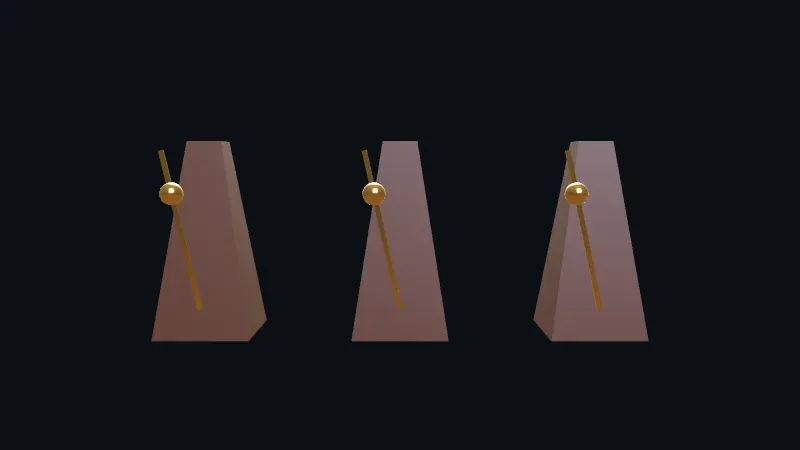
Live page: run it here
Open full screen. Try it: open it full screen with the Network tab of the developer tools: the three .glb files and the Draco decoder arrive with their sizes, the numbers exercise 3 asks you to measure.
$ node scripts/probe.mjs 04-gltf{ "backend": "WebGPU", "gpu": "nvidia, blackwell", "frame": 4, "render": { "calls": 23, "drawCalls": 10, "triangles": 6709 }, ... "loaded": { "metronome.glb": { "extensionsUsed": [], "vertices": 1297, "clip": "swing" }, "metronome-draco.glb": { "extensionsUsed": [ "KHR_draco_mesh_compression" ], "vertices": 1287, "clip": "swing" }, "metronome-meshopt.glb": { "extensionsUsed": [ "EXT_meshopt_compression", "KHR_mesh_quantization" ], "vertices": 1295, "clip": "swing" } }, "dracoArmAngle": 12.5}- The three metronomes look the same, and the Draco copy’s arm is at 12.5° after three frames of 0.125 s: 0.375 s into the clip, on the way back from 25° to 0°.
- 10 draw calls: 3 meshes per model and the output pass. Each model has 16 + 12 + 2,208 = 2,236 triangles, and 3 × 2,236 + 1 = 6,709. The 23 calls are lesson 3’s: 17 for the environment’s PMREM, and 2 per frame.
- The vertex counts differ, and exercise 1 finds where the vertices went.
What the decoders weigh
Section titled “What the decoders weigh”The production build shows the other side of the trade:
$ npx vite build...dist/assets/draco_wasm_wrapper-fZCQGLGb.js 58.45 kBdist/assets/draco_wasm_wrapper-DxJM36Ib.js 58.76 kBdist/assets/draco_decoder-Z1_iN-Ht.wasm 192.42 kB │ gzip: 64.11 kBdist/assets/draco_decoder-C32yEggz.wasm 285.74 kB │ gzip: 89.66 kBdist/assets/draco_decoder-fzg4nYZr.js 719.41 kB...dist/assets/04-gltf-CCDSPzCq.js 80.55 kB │ gzip: 24.11 kB...Since r185, DRACOLoader needs no setDecoderPath: it locates the decoders shipped in the three package with new URL(…, import.meta.url) (DRACOLoader.js, lines 16-24); r184’s DRACOLoader has no such URL, and r180’s starts with an empty decoderPath. Vite sees the five URLs in the module and copies all five files into the build, 1.31 MB, although a browser with WebAssembly loads only two of them: the wrapper and the 286 kB decoder (lines 381-402). The smaller glTF-only decoder, 192 kB, is used when you pass the exported DRACO_GLTF_CONFIG to setDecoderPath, and the 719 kB draco_decoder.js is a fallback for browsers without WebAssembly. The meshopt decoder has no separate file: it is inside the page’s 80.55 kB chunk, with GLTFLoader and DRACOLoader.
For this model, Draco saves 88 bytes over meshopt on the wire, and costs about 90 kB of gzipped WebAssembly on the first load. Draco pays off on large meshes, such as scanned objects or terrain; for most scenes, meshopt with gzip is the better default, and it also compresses animations and instanced data, which Draco doesn’t.
Textures: KTX2
Section titled “Textures: KTX2”Geometry is often the smaller part of a model: a 2048 by 2048 texture takes about 16 MB of GPU memory once decoded, more with mipmaps, whatever the size of its PNG. KTX2 files with Basis Universal compression (KHR_texture_basisu) stay compressed on the GPU: KTX2Loader transcodes them to a format the GPU supports, such as BC7 on desktop GPUs or ASTC on phones. The loader needs its transcoder files and the renderer to detect the formats: new KTX2Loader().setTranscoderPath(…).detectSupport(renderer), then gltfLoader.setKTX2Loader(ktx2Loader). The course’s metronome has no textures, so this part isn’t measured here (to verify).
In GuitarAlchemist/ga
Section titled “In GuitarAlchemist/ga”GA loads glTF models in several components, and each one shows a point of this lesson at commit 05c8eda:
- A promise the loader doesn’t keep.
Guitar3D.tsxannounces “GLTF/GLB model loading with KTX2 texture compression support” and a “Meshopt decoder for optimized geometry” in its header (lines 1-12), but creates a barenew GLTFLoader()(line 189), with neithersetKTX2LoadernorsetMeshoptDecoder. A guitar exported with meshopt or KTX2 would fail with the errors quoted above. - Decoders from a CDN.
Ocean.tsxloads Draco’s decoders from Google’s servers,setDecoderPath('https://www.gstatic.com/draco/v1/decoders/')(line 339). With r180, a path is required. It makes the page depend on a third party at run time, and on a decoder version that three.js didn’t choose. After an upgrade to r185 or later, removing the line lets Vite bundle the decoder that matches the loader. - Silenced errors.
DemerzelFaceOverlay.tsxreplacesconsole.errorwhile its face model loads, to hide the KTX2 errors (lines 173-180), and restores it afterwards. The model’s KTX2 textures are skipped, which the comment accepts since the component replaces the materials; any other component that logs an error mentioning KTX2 during that time is silenced too.setKTX2Loaderwould remove the errors instead of hiding them. - A mixer with nothing to play.
HandAnimationTest.tsxcreates anAnimationMixerfor the hand model (line 231) and updates it every frame (line 157), but never callsclipAction: a mixer without actions moves nothing. The page moves the hand’s bones itself, by setting their rotations (line 389).
GA experiment
Section titled “GA experiment”Lesson 14’s experiment 6 compresses a fretboard wood texture to KTX2: Basis LZ ships it in 145 kB instead of 1.2 MB, and a procedural wood in TSL downloads nothing. The wood textures generated with ComfyUI are coming soon; the experiment uses a texture written by a script until then.
Key takeaways
Section titled “Key takeaways”- glTF 2.0 is the delivery format three.js is built around: a node tree, metallic-roughness materials with linear color factors, and animations as keyframe tracks.
GLTFLoaderreturnsgltf.scene, aGroup, andgltf.animations; names may be made unique, and code that finds objects by name depends on them.AnimationMixer.update(delta)moves the clock;clipActionreturns the action that holds time, speed, loop mode and weight.- Draco gives the smallest files and a large decoder; meshopt gives files that gzip well and a small decoder. Measure both, over the wire.
- Since r185,
DRACOLoaderfinds its decoders by itself, and a bundler copies all of them into the build.
Exercises
Section titled “Exercises”- The uncompressed model has 1,297 vertices, the Draco copy 1,287 and the meshopt copy 1,295, yet the three metronomes look the same and have the same number of triangles. Where did the vertices go? Check with
scripts/l04-exercises.ts, which decodes both copies in Node.js with glTF Transform. - Where is the arm at 0.875 s? Then play the clip once, with
LoopOnceandclampWhenFinished = true, for 1.5 s: where is the arm, what isaction.time, and is the action still running? - A page shows one 3 MB scanned model, and another shows 40 small models of 50 kB each. Which compression would you pick for each, and what would you measure before deciding?
Solution 1
$ node scripts/l04-exercises.tsmetronome.glb body 48 vertices, 16 triangles | rod 24 vertices, 12 triangles | weight 1225 vertices, 2208 trianglesmetronome-draco.glb body 40 vertices, 16 triangles | rod 24 vertices, 12 triangles | weight 1223 vertices, 2208 trianglesmetronome-meshopt.glb body 48 vertices, 16 triangles | rod 24 vertices, 12 triangles | weight 1223 vertices, 2208 triangles...Two causes. The weight, a SphereGeometry with 48 segments, has 49 vertices in its top and bottom rows, but the triangles of each pole use only 48 of them: vertices 48 and 1176 belong to no triangle. Both encoders drop vertices that no triangle uses, since they rebuild the buffers from the index. The body loses 8 more in the Draco copy only: glTF Transform’s draco() first welds vertices that have the same attributes (draco.ts, line 71), and the body had been made non-indexed, with a copy of each corner per triangle. meshopt() reorders the vertices but doesn’t weld them.
Solution 2
t = 0.875 s: arm at -12.5°LoopOnce, clampWhenFinished, after 1.5 s: arm at 0°, action.time 1, running false, finished events 1At 0.875 s, the arm is halfway from −25° at 0.75 s back to 0° at 1 s. Played once, the action stops at the end of the clip: its time stays at 1, isRunning() is false, and the mixer dispatches one finished event, which is where a page would start the next animation. clampWhenFinished keeps the last pose; without it, the documentation says the action is disabled when it ends and no longer affects the object. This clip ends at 0°, where it started, so the difference doesn’t show here: try it with a clip that ends elsewhere.
Solution 3
For the 3 MB scanned model, Draco: dense, irregular geometry is where its encoding gains the most, and one decoder download of about 90 kB gzipped is small next to the megabytes saved. For the 40 small models, meshopt: the files gzip nearly as well as Draco’s, the decoder is already in the JavaScript bundle, and it aims at fast decoding, which matters when 40 files arrive together. Measure the transfer size with the server’s real compression, the time from request to first frame, and decoding time on a slow phone, not the size on disk. This answer is reasoned from this lesson’s measurements on one small model, not measured on those two pages (to verify).
Sources
Section titled “Sources”- Khronos: glTF 2.0 specification,
KHR_draco_mesh_compression,EXT_meshopt_compression,KHR_mesh_quantization,KHR_texture_basisu - three.js manual: Loading 3D models; documentation:
GLTFLoader,DRACOLoader,KTX2Loader,AnimationMixer,AnimationAction - three.js source at r186:
GLTFLoader.js,DRACOLoader.js - glTF Transform 4.5.0:
dracoandmeshopt - Draco, Google; meshoptimizer